The three names overlap so much that people use them as if they meant the same thing. They do not, and the gaps between them decide practical things: where you can work, which days count against a visa-free stay, and whether a residence permit gets you across a border.
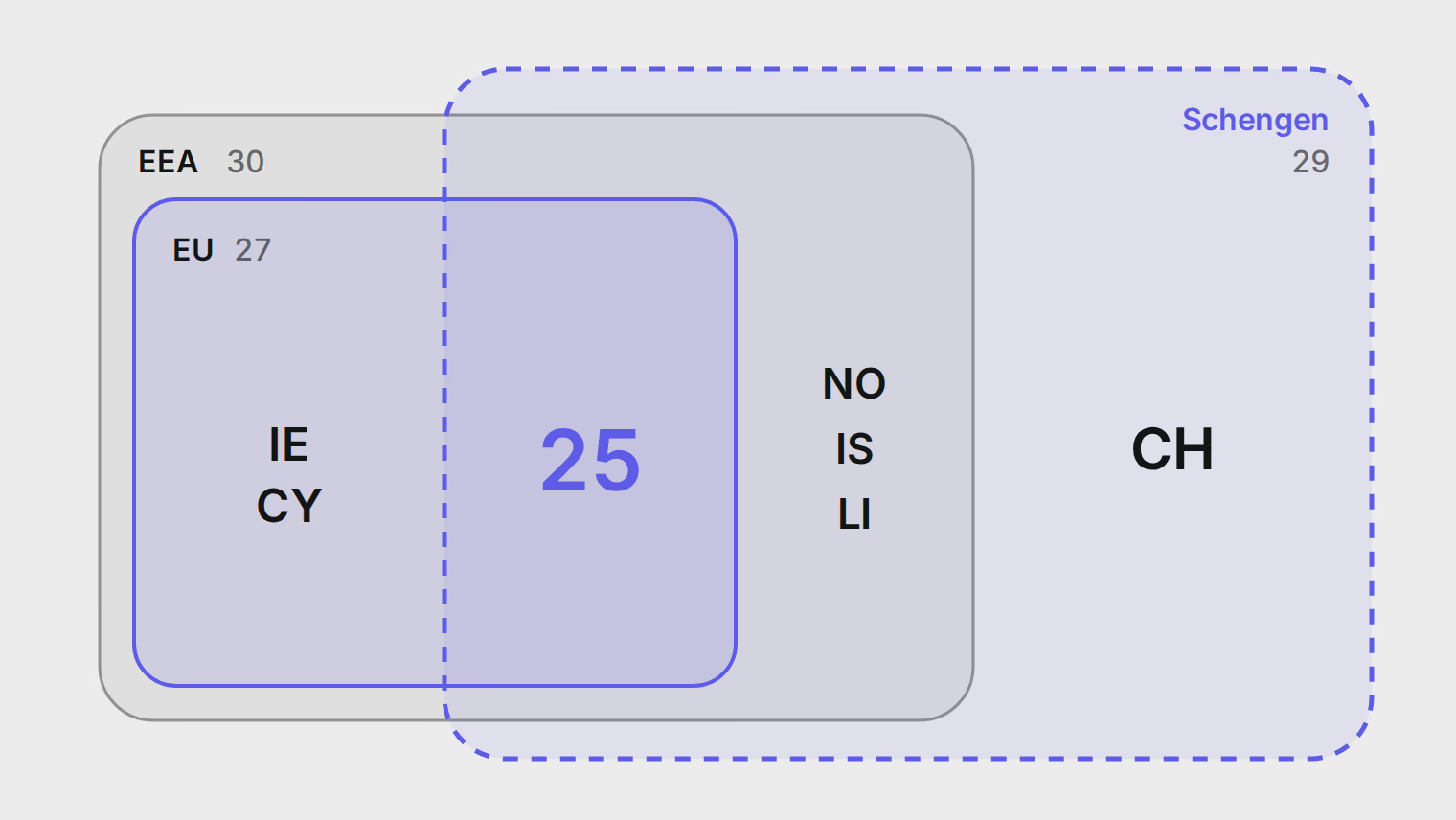
- EU member states
- 27
- EEA countries: the EU plus Iceland, Liechtenstein and Norway
- 30
- Schengen countries, without border checks between them
- 29
- Non-EU short-stay days in any 180, shared across Schengen
- 90/180
So the question "is it in Europe's club?" has no single answer. Ask instead: which right do I need, and which agreement gives it?
Who is in which
Most EU countries are in all three. The interesting rows are the exceptions. This table reflects the official lists as of October 2026.
| Country | EU | EEA | Schengen | What it means in practice |
|---|---|---|---|---|
| 23 other EU members, from Austria to Sweden | Yes | Yes | Yes | One area for free movement and for borders |
| Ireland | Yes | Yes | No | EU free movement applies, but Ireland keeps its own border and visa rules |
| Cyprus | Yes | Yes | Not yet | Takes part in Schengen cooperation, but as of October 2026 the Council has not lifted its internal border checks |
| Bulgaria, Romania | Yes | Yes | Yes, since 1 January 2025 | The most recent Schengen members |
| Iceland, Liechtenstein, Norway | No | Yes | Yes | Not in the EU, but free movement applies through the EEA Agreement |
| Switzerland | No | No | Yes | Free movement through a bilateral agreement in force since 1 June 2002 |
Sources: the European Commission's Schengen area page, the EU's list of member countries, the European Parliament's fact sheet on the EEA and Switzerland and the Swiss State Secretariat for Migration on the free movement agreement.
Two details trip people up. The EEA Agreement entered into force on 1 January 1994, and EEA membership is compulsory for EU countries, so every country that has joined the EU since then has also joined the EEA, through its own EEA enlargement agreement rather than automatically. Today "EU" always implies "EEA". And Schengen membership says nothing about the right to work: Switzerland is in Schengen without being in the EEA, while Ireland gives EU workers full rights and stays outside Schengen.
If you hold an EU, EEA or Swiss passport
Your right to move comes from EU law and its extensions, not from Schengen. Under the EU's residence rules:
- You can live in another member state for up to 3 months with a valid passport or ID card.
- To stay longer, you need to be working, self-employed, studying, or able to support yourself with health insurance. Many countries require you to register after 3 months.
- After 5 years of legal residence you gain the right of permanent residence.
The same freedoms reach Iceland, Liechtenstein and Norway through the EEA, and Switzerland through the bilateral agreement, though each applies them with its own procedures. Ireland belongs here too: an Irish passport, or any EU passport in Ireland, works under these rules, even though Ireland is outside Schengen.
If you are not an EU national: the short-stay rules
For visitors, Schengen is the club that matters. Its common visa rules cover stays of up to 90 days in any 180-day period across all 29 countries together. Three consequences follow.
The 90 days are shared. A month in France and two months in Spain use up the whole allowance. They are not separate counters.
The window rolls. On any given day, count back 180 days and add up the days you spent in the area. The European Commission publishes a short-stay calculator that does this for you, and it is worth using before you book a long trip.
Ireland and Cyprus sit outside the count. According to the EU's guidance for non-EU nationals, EU visa rules do not apply in Cyprus and Ireland: both issue their own national visas, and days spent there do not count toward the Schengen 90. One asymmetry is easy to miss: a valid Schengen visa or residence permit can be used to travel to Cyprus, but a Cypriot visa or permit is not valid for the Schengen area.
Counting is also no longer a matter of passport stamps. The EU's Entry/Exit System registers each entry and exit of non-EU short-stay travellers at the external borders of the 29 countries, including fingerprints and a facial image. It started on 12 October 2025 and fully replaced stamping on 10 April 2026, which means overstays are detected automatically.
A worked example: what one residence permit covers
Take a non-EU software developer who moves to Lisbon on a Portuguese residence permit for work. Here is what that one card does and does not do.
| Question | Answer | Why |
|---|---|---|
| Can she live and work in Portugal? | Yes, on the permit's terms | It is a national permit issued by Portugal |
| Can she visit Berlin for a week? | Yes | A Schengen residence permit replaces the visa for short stays in the other Schengen countries |
| Does the trip count against 90/180? | Yes, for days outside Portugal | Short stays elsewhere in Schengen follow the common rules |
| Can she take a job in Berlin? | No, not on this permit | Work rights stay national; she needs a German permit |
| Can she visit Cyprus? | Yes | Cyprus accepts Schengen permits for travel |
| Can she visit Dublin? | Depends on her nationality | Ireland applies its own visa list |
What changes this picture is time and permit type. After five years of legal, continuous residence she can apply for EU long-term resident status, which is designed to make moving to another EU country for work or study easier. If instead she had come on an EU Blue Card, she could apply to move to another member state for a highly qualified job after 12 months under simpler rules. The second country can only refuse on the basis of a labour market check if it runs the same check on first-time applicants (Directive (EU) 2021/1883, Article 21). The Blue Card applies in 25 member states: Denmark and Ireland are not part of it.
The pattern holds well beyond Portugal. Schengen governs crossing borders. National law, and in some cases EU directives, govern living and working. A residence permit is a national document that happens to carry Schengen travel rights, not a European work permit.
Five questions to ask of any European country
Before you shortlist a country, answer these from the official sources above, not from a summary:
- Is it in the EU, the EEA, or neither? This tells you whether EU free movement applies to you, if you hold a European passport, and whether EU directives such as the Blue Card apply.
- Is it in Schengen? This decides how your visits are counted and whether a permit from there lets you travel to the rest of the area.
- Which permit will you hold, and who issued it? Work rights follow the issuing country.
- Does it take part in the specific EU scheme you are relying on? Denmark and Ireland are outside the Blue Card. Check participation for any scheme by name.
- When were the rules last changed? Schengen gained two members in 2025 and changed its border checks in 2026. Treat any article, including this one, as a snapshot and check its date.
On the map, the EU, Schengen and EEA filters use the same membership lists as the table above, so you can see the three overlapping areas at a glance before you open individual country profiles.